

Ellie Davies
Associate Landscape Architect
Colour by context: Environmental Colour Assessment for sensitive landscape-led design
How can evidence‑based colour analysis of site context steer smarter design decisions, strengthen planning submissions and raise the overall quality of design in the external environment?
Most construction projects aspire to respond to their surroundings, using built form to reinforce local character and placemaking. Yet few can demonstrate this in a measurable way. Colour is often treated as a matter of taste, but it has a clear, quantifiable influence on assimilation of development into its surroundings, user perception, place experience, and the way planning authorities judge a scheme.

What is Environmental Colour Assessment (ECA)?
Environmental Colour Assessment (ECA) reframes colour as an objective, contextual design parameter. By analysing the colours, tonal ranges and materiality of the existing environment, ECA provides robust evidence for why a proposal reads as contextually appropriate with the potential to minimise landscape and visual impacts through optimising the external materials palette.
ECA can be highly prescriptive where required, or it can provide an evidence‑based starting point for the design team. It supplies the data from which colour palettes can be developed, allowing designers to exercise aesthetic preference and creativity, with the confidence that chosen colours will work within the specific context and deliver the desired performance.
A brief historical context
ECA emerged in France and Italy in the 1960s and 1970s, driven by concerns that industrialisation and transport infrastructure were eroding local identity. The approach reached the UK in the early 1980s, as colour specialists and landscape professionals began to recognise the strategic role of colour in the built environment.
In the UK, ECA has gradually been incorporated into supplementary planning guidance and is often prepared alongside Landscape and Visual Impact Assessments (LVIAs), informing mitigation strategies and design evolution.
Principles and process of ECA
ECA is still a relatively young discipline in the UK. Sweco’s involvement began with a new hospital project located within a highly sensitive Special Landscape Area. Successful integration of the building was essential to landscape and visual mitigation and was secured in part as a condition of Reserved Matters planning approval through the production of an ECA.
Sweco landscape architects undertook the ECA, collaborating with the project architects and local planning authority. The outcome was a carefully calibrated material and colour strategy that both integrated the building into its setting and strengthened placemaking through accent colours derived from local built form.
The assessment revealed the subtlety of colour in the surrounding landscape and townscape, enabling place‑specific colour selection and reliable assimilation of the building into its context. Since then, Sweco has continued to refine and consolidate its ECA methodology in line with published guidance, offering ECA as a landscape architectural service.
At present, formal guidance is limited. The principal UK reference is:
Landscape Institute Technical Information Note 04/2018 – Environmental Colour Assessment.
While each project is unique, a typical ECA follows these stages in line with the above guidance.

Aims and objectives
The scope and intent of the assessment are established at the outset. This includes clarifying whether the proposal should:
- Camouflage within its setting,
- Integrate quietly but legibly, or
- Deliberately accent as a feature
These objectives guide the subsequent analysis and palette development.
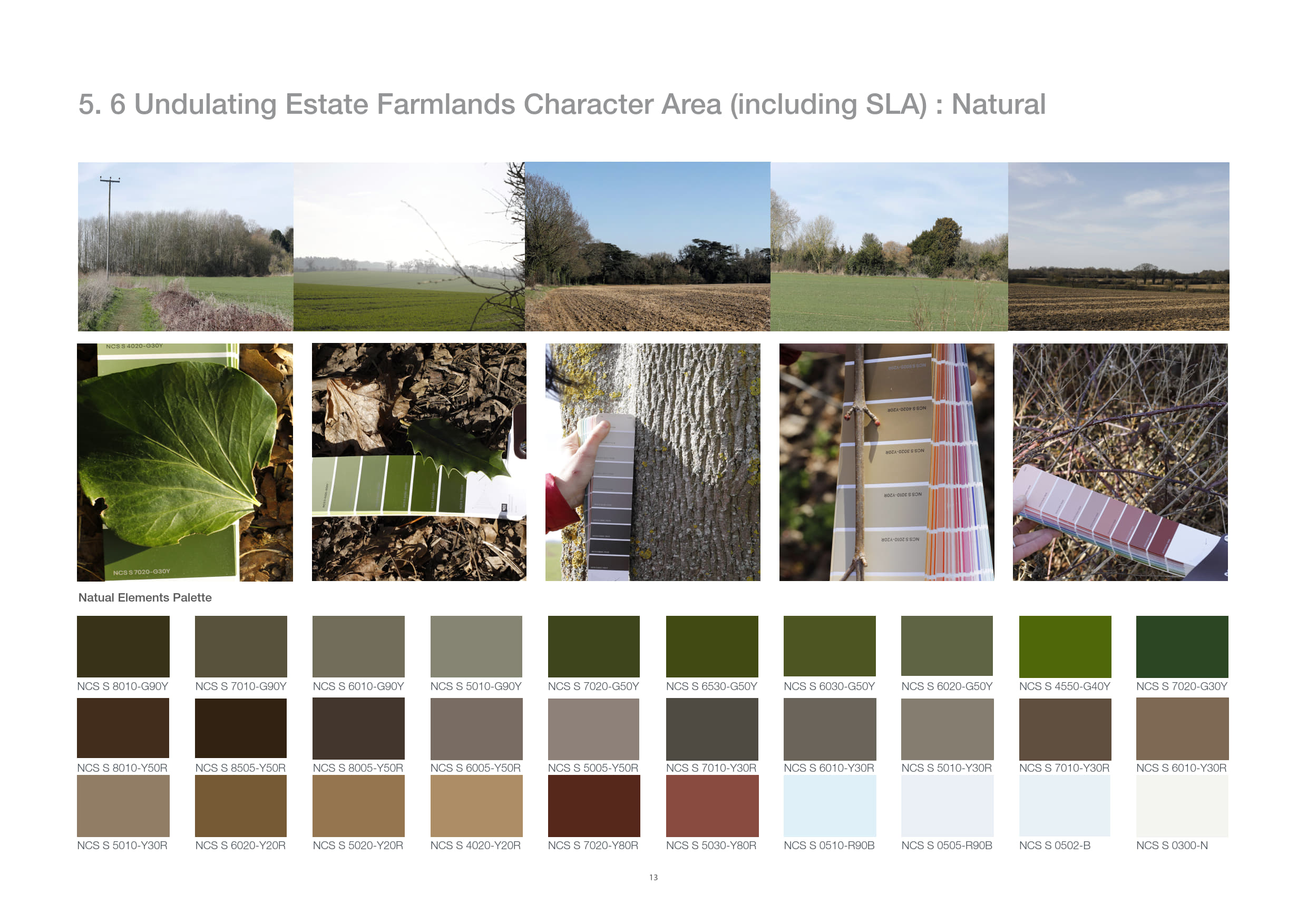
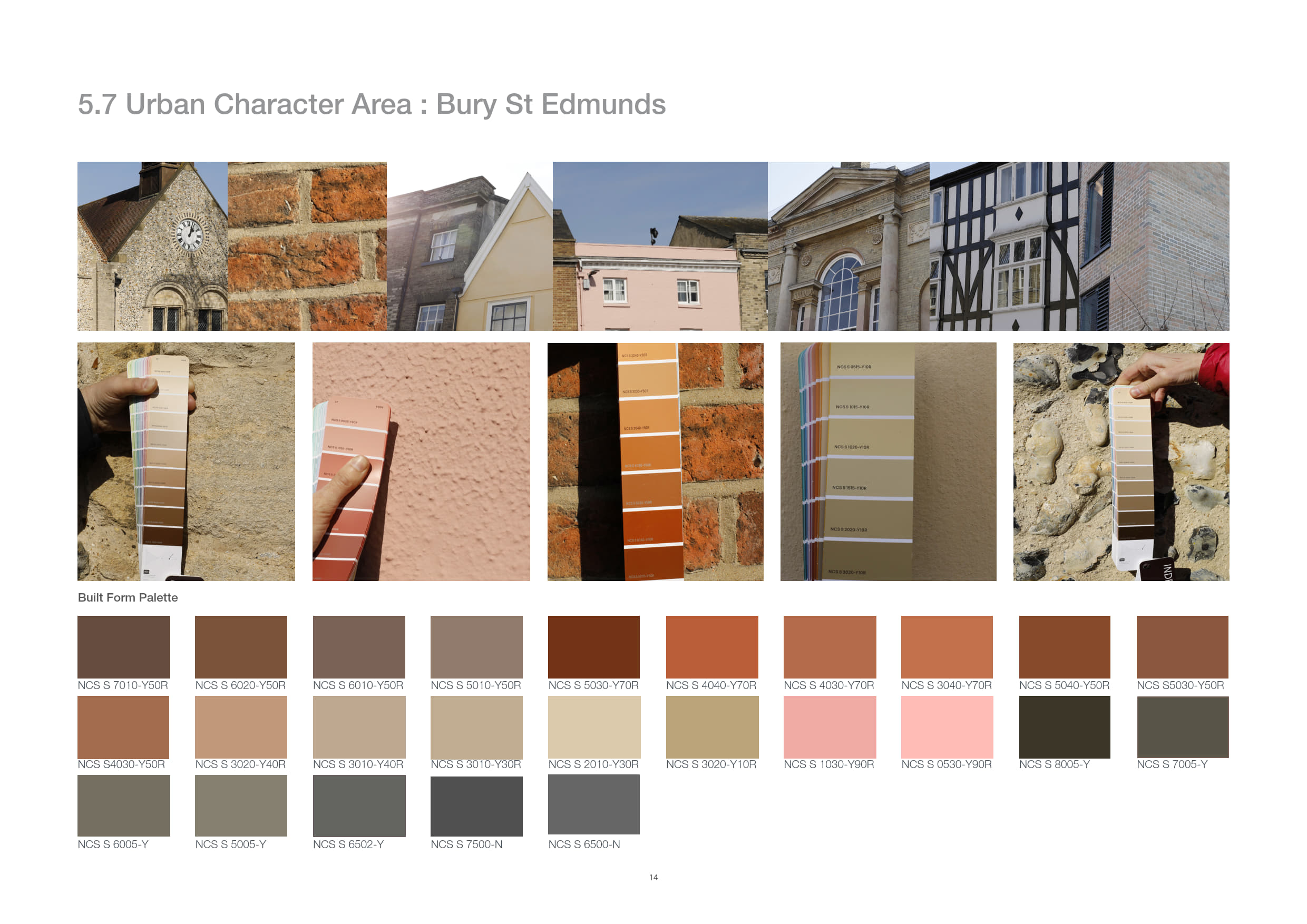
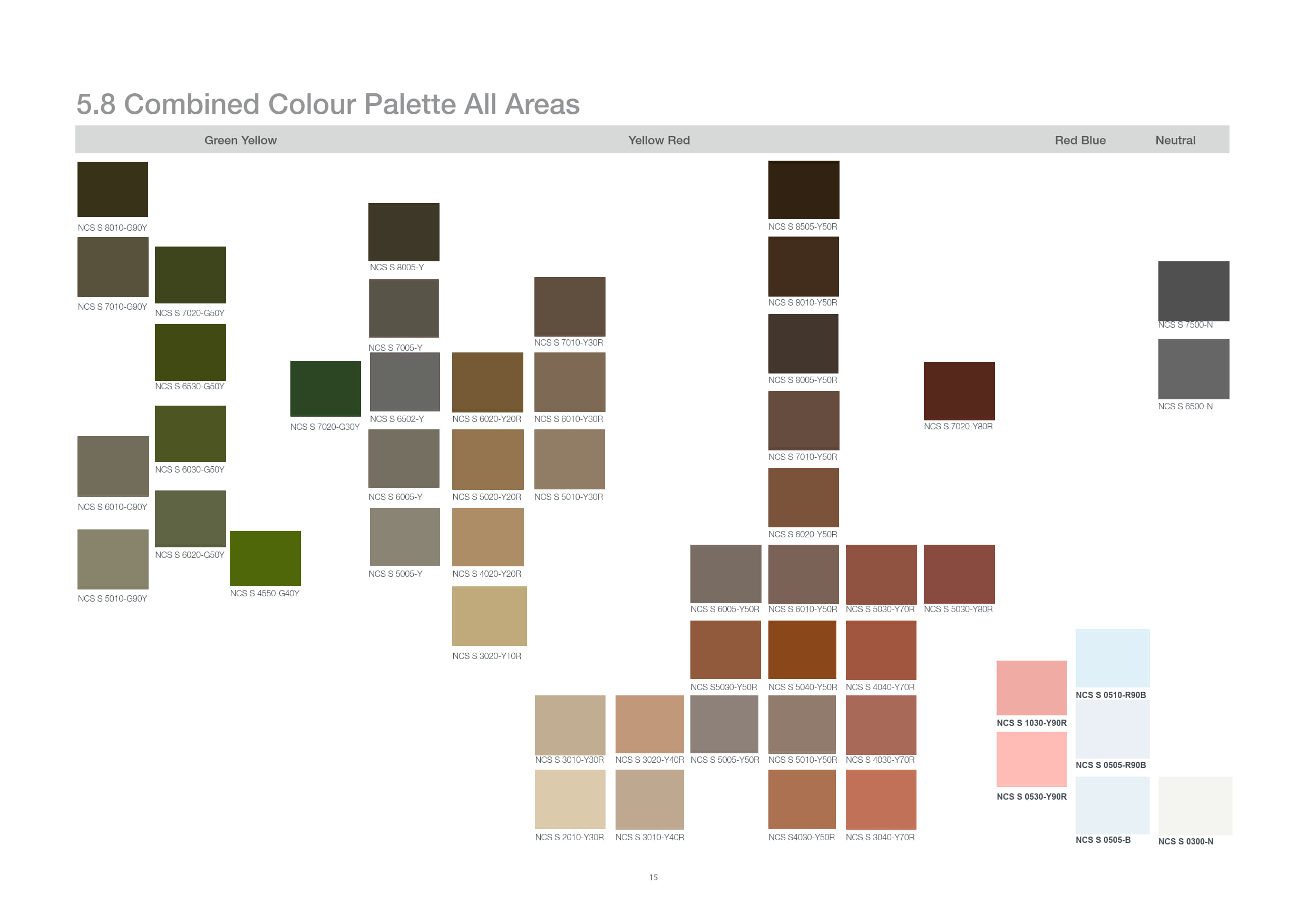
Desktop contextual analysis
Existing information is reviewed to understand the wider landscape and townscape context. This often includes:
- Landscape character assessments,
- Previous LVIAs or landscape and visual appraisals (LVAs),
- Relevant planning or design guidance.
Where Sweco has prepared the LVIA/LVA, the ECA builds directly on that work, linking colour strategy to established landscape and visual receptors and sensitivities.
Site surveys and colour recording
Field surveys are then undertaken to capture:
- Dominant and secondary colours,
- Tonal ranges, textures and material finishes
Colour is never perceived in isolation. Understanding this broader visual context is critical to identifying appropriate colours
The Natural Colour System (NCS) is used to identify and record colours on site. Because NCS is based on human colour perception rather than device output, it avoids distortions introduced by screens or print processes. On‑site colour identification using a the NCS system is essential for:
- Accurately recording colours under real conditions,
- Communicating colour consistently across disciplines,
- Ensuring precise replication across materials and manufacturing processes.
Viewpoint‑based colour assessment
Key viewpoints – often defined within a Landscape Visual Impact Assessment (LVIA) – are reviewed in detail to understand how colour and material choices will read in critical views. Additional viewpoints may be selected where colour is particularly important to the appearance of the proposed development.
From each viewpoint, the assessment considers:
- Background and foreground tones,
- Contrasts against sky or landscape,
- Seasonal and atmospheric variation (e.g. foliage, haze).
Palette development
Colours recorded on site are analysed and synthesised into representative palettes that express the character and qualities of the area. These palettes are then refined in line with the agreed objectives.
The process draws on core colour theory, including:
Distance effects:
Colours seen at distance often appear lighter and less saturated. Atmospheric scattering can shift hues towards blue, particularly over long sightlines.
Light and materiality:
Illumination, surface texture, reflectivity and sheen significantly alter perceived colour. For example, highly reflective black surfaces can appear bright or even white under certain lighting conditions.
Tonality and visibility:
When the aim is to visually recess a development in the landscape, tones are chosen to match or be slightly darker than the prevailing background against which the development will be seen (noting that this varies between viewpoints).
When the aim is to create a landmark visible from distance, tones are typically lighter than the contextual landscape, increasing contrast and legibility.
The result is a structured palette (or set of palettes) that supports the desired level of prominence while remaining grounded in the local context.

Collaborative testing and refinement
ECA is inherently collaborative. Practitioners work closely with architects, landscape architects and clients as part of an iterative design process to ensure colour selection is consistent with the objectives of the project.
Before finalising the palette, physical samples are often tested on site under different lighting and weather conditions. This step validates that colour and material choices perform as intended and fulfil the agreed ECA.
The future of Environmental Colour Assessment
ECA remains a developing field, but its relevance is growing. Increasing expectations for development to be landscape‑led and follow an iterative design process, mean that ECAs are more frequently requested alongside LVIAs/LVAs as part of planning submissions. ECAs are also being embedded in supplementary planning documents and design codes, especially in areas of high landscape sensitivity such as National Landscapes.
Greater awareness is likely to drive the future production of further guidance and best‑practice frameworks. At the same time, future technological advances—such as improved digital colour analysis, high‑fidelity visualisation, and environmental simulations— will ultimately be able to enhance the ability to predict colour performance under varying light, weather and seasonal conditions.
As pressure on both rural and urban environments intensifies – from housing demand to the infrastructure required for the green transition – the role of ECA becomes more valuable. By providing a clear, evidence‑based framework for context‑appropriate colour selection, ECA supports:
- More successful assimilation of development into its setting,
- Context appropriate colour selection for stronger placemaking and distinct local identity,
- Context appropriate colour selection for improved user experience and wellbeing,
- More persuasive, transparent planning submissions.
In short, Environmental Colour Assessment elevates colour from subjective afterthought to a disciplined, evidence‑led component of high‑quality design in the external environment.
For further information refer to:
Landscape Institute, Technical Information Note 04/2018 ‘Environmental Colour Assessment’, 2018
Lancaster, Michael: Colourscape, Academy Editions, 1996