
Dr Martin Brammah
Ecology Lead
Biodiversity projects: From loss to gain
Biodiversity is fundamental to the stability and resilience of our built environment. While the scale of current biodiversity loss is unprecedented, the urgency to act is matched by the opportunity to make a meaningful difference – starting with the design process itself.
Integrating biodiversity early is not only a matter of ecological stewardship; it is an essential strategy for ensuring long-term resilience and sustainability of societies, economies, and individual projects. The benefits reach beyond immediate environmental concerns, touching on public health, resource security, and our overall quality of life.
Explore our biodiversity projects across Europe
By considering biodiversity from the very start, we can help safeguard the essential services that healthy ecosystems provide—clean water, fertile soils, climate regulation, and more—while also upholding our responsibility to future generations.
Sweco’s approach is rooted in collaboration, technical expertise, and a commitment to tangible outcomes. Rather than focusing on the risks associated with biodiversity loss, we instead concentrate on the opportunities for positive change that arise when nature is integrated into planning and development.
This means adopting nature-based solutions that restore urban and rural ecosystems, using digital technologies and data-driven insights to enhance biodiversity performance, and designing infrastructure that supports both ecological and human well-being.
We support our clients with practical tools and methodologies, from GIS-based biodiversity mapping and assessment, to the application of ecosystem service models and science-based targets for nature-positive development.
Our experts work alongside project managers to embed biodiversity considerations into every phase, identifying synergies with climate adaptation, circular economy principles, and stakeholder engagement. Through habitat restoration, green infrastructure, and innovative design, we demonstrate how biodiversity integration can bolster project resilience, reduce long-term operational risks, and generate measurable benefits for communities.
While the scale of current biodiversity loss is unprecedented, the urgency to act is matched by the opportunity to make a meaningful difference – starting with the design process itself.
Dr Martin Brammah, Sweco UK Ecology Lead
Today, a new generation of tools and techniques is transforming how we understand and deliver on biodiversity. Novel methods such as species detection dogs, environmental DNA (eDNA) surveys, drone-based remote sensing, and AI-driven habitat identification enable us to collect richer, more accurate baseline biological data than ever before. This empowers project teams to make informed decisions that truly reflect local ecological conditions.
Moreover, there is growing global interest in tools that can measure the change in biodiversity value associated with development, such as England’s Biodiversity Net Gain, and the Netherlands’ Nature Points system. These approaches enable us to transparently assess impacts and set clear targets for improvement. Innovative design solutions are also making it possible to avoid and minimise biodiversity loss – for example, by creating functional ecosystems from scratch as part of urban redevelopment on former landfill sites, or by weaving biodiversity into the design of cycleways and other infrastructure. By leveraging these advances, we can move beyond mitigation towards regeneration, ensuring that every development contributes positively to nature.
Sweco understands that reversing biodiversity loss is a complex challenge, but also a profound opportunity. The value of partnering with clients, communities, and stakeholders to navigate the transition towards resilient, nature-positive environments cannot be overstated. This report offers actionable insights and proven strategies, designed to guide project managers from initial awareness to practical implementation.
By working together, we can move beyond compliance and mitigation, towards regeneration and stewardship. The journey requires systemic change, but the tools and knowledge are available today. With early and integrated action, we can create built environments that not only minimise harm, but actively contribute to the health and vitality of nature and society.

Biodiversity project examples
In the UK
Biodiversity Net Gain (BNG) is a legal requirement in England under the Environment Act 2021. It mandates that developers leave nature in a measurably better state after construction than before.
Sweco UK supported an outline planning application for a circa 50 MW Battery Energy Storage System (BESS) at the former Rooscoote Power Station in Barrow-in-Furness, England, for CBS Energy Storage Assets UK Limited. To inform BNG calculations, the ecology team conducted a UK Habitat (UKHab) classification survey across
3.35 hectares of land. The UKHab survey mapped habitats and assessed their condition–vital data for completing the Statutory Biodiversity Metric. Biodiversity value is expressed in Biodiversity Units, with more valuable habitats being assigned higher Unit scores.
Using the Metric, the site’s baseline was calculated as 3.17 Biodiversity Units for area-based habitats and 0.04 Units for linear habitats. To achieve the statutory 10% net gain, post-development targets were 3.487 area-based Units and 0.044 linear Units.
Sweco created a colour-coded map showing the relative value of habitats on-site. This was used to guide planning application boundaries and layout, helping avoid high-value habitats, optimise project viability and reduce costs associated with BNG. Our team presented the client with four scenarios ranging from achieving BNG within the site boundary to purchasing Biodiversity Units from a ‘habitat bank’–where third-party sites that legally commit to maintain habitats for 30 years and generate Units for developers to purchase.
After a cost-benefit assessment, the client selected Sweco’s recommended option. This scenario delivered an 11.99% net gain for area-based habitats and an impressive 763.05% net gain for linear habitats, satisfying Metric trading standards by replacing lost habitats with those of equal or higher ecological value. With the BNG scenario agreed, Sweco produced a Biodiversity Gain Plan for inclusion in the client’s outline planning application. The client is awaiting a decision from the local authority.
Establishing 11.99% net gain relied on:
• The retention of two medium-sized, moderate-condition trees on site.
• The retention of 0.50 ha of modified grassland in poor condition.
• The retention of 0.01 ha of bramble scrub.
• The creation of 0.12 ha of other neutral grassland in moderate condition.
• The creation of 0.14 ha of mixed scrub in moderate condition.
• The planting of 35 small individual trees in moderate condition.
• The creation of 0.05 km of native hedgerow with trees in a moderate condition.
“BNG was introduced to help halt biodiversity loss and embed nature within the planning system. It requires most developments in England to deliver at least a 10% net gain in biodiversity value, making early engagement with ecologists essential. This is particularly important as the cost of purchasing Biodiversity Units -or more expensive
Statutory Biodiversity Credits – to offset habitat loss can be high, and developers must ensure that habitats created or enhanced for BNG are maintained for at least 30 years after completion.”
Dr Martin Brammah, Sweco UK National Ecology Lead
Across Europe
Avoiding biodiversity loss and reducing costs in road construction
Avoiding loss of biodiversity and reducing the costs of road construction, Norway: Reusing existing road corridors and protecting peatlands reduces costs, emissions and habitat disturbance.
“The ability to work multidisciplinary is crucial for reducing negative impacts on biodiversity and the environment, with the biggest gains often achieved in the early project stages. This comprehensive approach enables us to deliver optimal value for road users, society and the future.”
Stian Blindheim, project manager E18 Kragerø-Bamble, Nye Veier
A future-proof city with coastal protection for people and nature
Coastal protection, Sweden: Nature-based solutions such as wetlands and artificial reefs boost biodiversity and climate resilience. The city identified a need for coastal protection outside its harbour to reduce storm impacts expected to increase with rising sea levels. It sought solutions that minimise negative effects on marine and coastal environments.
“For our organisation, it is not only about conserving nature–but about being part of it. We see nature-based solutions as a way to bring together climate adaptation and coastal protection, recreation, and ecological values.”
Pär Svensson, Acting Section Manager, Land Development Division, City of Malmö
A new neighbourhood with a positive contribution to nature
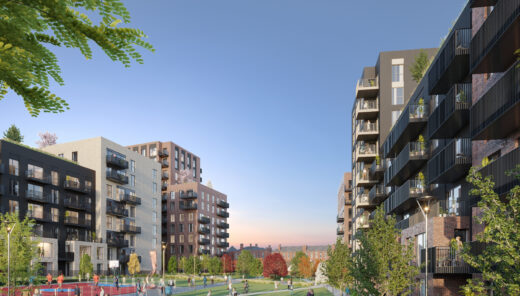
Fælledby, Denmark: A new district on a former landfill creates high-quality local habitats and engages residents. Can a new urban district–built on a former landfill–contribute positively to local biodiversity? Fælledby, an 18-hectare urban development project in Copenhagen, Denmark, aims to do just that by 2030. The strategy focuses on offsetting lost green space by creating higher-quality habitats and fostering citizen engagement.
“Biodiversity matters to us because it matters to the people who will live in Fælledby. Our ambition is to create the best possible framework for life to benefit people and nature.”
Martin Baltser, Project development director, Fælledby
Biodiversity handbook in power line corridors and station areas
The Power Line Biodiversity Handbook, Sweden: Practical tools to help energy operators integrate biodiversity into everyday planning and operations.
“This handbook empowers grid operators to make biodiversity a core part of their operations: collaborate, map high-value nature with GIS, manage corridors as habitats, and document progress to meet environmental objectives and international frameworks.”
Eva Grusell, Ecologist, Sweco
Minimising biodiversity loss and use of virgin raw materials in a cycling highway
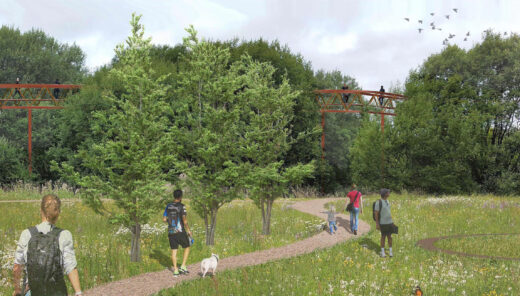
Kolenspoor Cycling Highway, Belgium: Adaptive lighting, eco-tunnels and recycled materials decrease species impact while revitalising regional mobility. Preparing the cycling highway required avoiding negative impacts on the sensitive environment.
“The biggest challenge lies in realizing infrastructure projects in ecologically sensitive environments, where every step must be carefully weighed to preserve and enhance local biodiversity – while also promoting innovative, sustainable construction solutions wherever possible.”
Stijn Van Dingenen, Projectmanager, Limburg
Revolutionising biodiversity research with a little help from bees and eDNA
An innovative project in Finland is using bees for eDNA-based research. The bees return not only with pollen but also with plant eDNA from their foraging trips. By analysing this pollen using eDNA technology, experts can determine which plants the bees visit and assess how tramway construction impacts local vegetation and the bees’ habitats.
“The importance of urban greening becomes more prominent with future challenges such as heatwaves and flood forecasting. Having bees collect undeniably accurate environmental data contributes to our mission to further improve environmental management and the resilience of urban areas.”
Jyrki Lehtimäki, Urban green expert at Tampere city

5 key trends driving Europe’s biodiversity agenda
- 1. Biodiversity in Finance
There is a growing trend across Europe towards increased assessment and disclosure of biodiversity impacts by businesses and financial institutions, driven by the recognition of financial risks associated with biodiversity loss.
Global frameworks like Science-Based Targets for Nature enable companies and cities to set targets for their work on the climate and nature, and the Taskforce on Nature-related Financial Disclosures (TNFD) helps companies mitigate biodiversity-related risks. These frameworks are increasingly used by companies to enable systematic value-chain analyses, target setting and disclosures. The Corporate Sustainability Reporting Directive (CSRD) includes reporting standards that also enable companies to disclose their contributions to biodiversity loss.
- 2. Biodiversity Credit Markets
Increased assessment and disclosure of biodiversity impacts has led to the development of biodiversity offset and credit markets, which allow organisations to compensate for their impacts by investing in conservation efforts.
The UK and Germany are working with biodiversity credit markets, allowing businesses to offset their impact through conservation investments. In England, the Biodiversity Net Gain (BNG) policy sets a global benchmark, requiring a 10% improvement in biodiversity for new developments. The BNG is a development approach that requires developers in England to enhance wildlife habitats by at least 10% beyond their original state.
- 3. Restoration and Conservation Investments
This trend is marked by the establishment of various funding mechanisms aimed at supporting biodiversity initiatives, such as Horizon Europe and the LIFE Programme. Despite these efforts, the European Commission has identified a funding gap, prompting the exploration of new financial instruments. Public-private partnerships (PPPs) are increasingly being utilised to finance conservation projects, while national initiatives, like Denmark’s ‘Grøn Trepart,’ aim to repurpose farmland for biodiversity restoration.
Governments and businesses are scaling up restoration. Germany has pledged €4 billion, while Denmark is converting 400,000 hectares of land into wetlands and forests. Public-private partnerships facilitate collaboration that help define common priorities, which could be the key to driving large-scale conservation efforts across Europe.
- 4. Biodiversity in Cities
This trend is partly driven by the EU Restoration Act, which requires the maintenance and expansion of green spaces and tree canopies in cities. This regulation, along with initiatives aimed at ‘wilding’ urban environments, seeks to restore natural ecosystems, create ecological corridors and involve citizens in sustainable planning, enhancing ecosystem services, improving climate resilience and promoting biodiversity in cities.
Swedish municipalities receive support for integrating ecosystem services and green infrastructure through the national Guidance for Green Planning. In the Netherlands, many municipalities now require nature-inclusive design as part of the process for issuing building permits; developers can score ‘nature points’ through features like green roofs and provision for wildlife. In Belgium, Antwerp is investing in a circular water network that purifies and reallocates freshwater for urban use, replenishing groundwater and enhancing biodiversity.
- 5. Digital and AI-Powered Biodiversity Solutions
Technology is transforming conservation. AI-driven satellite imagery, vegetation monitoring drones, acoustic sensors, digital twins and biodiversity tracking apps like Seek and Pl@ntNet enhance monitoring, and tools like wildlife cameras are enabling real-time biodiversity assessments.
Sweco’s latest Urban Insight report details practical tools, design approaches and actionable recommendations to help project owners, designers, and planners integrate biodiversity at every stage of development. Download our FREE release below.
Trending expertise
Net zero

Nature-based Solutions

Energy infrastructure

Building Safety Act 2022

Green transition
Placemaking

Data centres

Sustainable transportation

