Urban Insight
Sweco Group
How to increase biodiversity
Now is the time to scale up innovative solutions for increasing biodiversity to secure resilient societies and businesses for the future. Development projects can have a significant impact on nature – but by planning and executing them mindfully, it’s possible to avoid unnecessary impacts and in turn go on to enhance biodiversity.
Embedding biodiversity considerations into every development project phase, while identifying synergies with climate adaptation, circular economy and stakeholder engagement, is essential to future-proof development, bolster project resilience, reduce long‑term operational risks and generate measurable community benefits through habitat restoration, green infrastructure and innovative design.
Here, we explore how to increase biodiversity with 9 key recommendations from our latest Urban Insight report.

1. Adopt a biodiversity-first approach
Place biodiversity on an equal footing with other design priorities such as safety, cost and technical performance. Land use competition often pushes nature to the margins, unless biodiversity is integrated from the outset. Embed ecological goals in early-stage planning, policy and procurement to ensure nature is considered before design choices are locked in.
2. Involve ecological expertise early
Engage ecologists and biodiversity specialists from the very beginning of project development. Their insight ensures that digital tools such as AI-based inventories are correctly interpreted and that design decisions reflect ecological realities. For large organisations operating globally, adapt biodiversity strategies to each location’s unique ecosystems, regulations, and cultural contexts.
3. Foster multi-disciplinary collaboration
Addressing complex biodiversity challenges requires the combined efforts of multiple disciplines. Facilitate cooperation among biologists, engineers, urban planners, economists, sociologists, and other experts. Through interdisciplinary teamwork, innovative and effective solutions that balance ecological and development goals can be achieved. Promoting such collaboration ensures comprehensive approaches to biodiversity conservation.
4. Integrate multiple functions
Plan to deliver multiple benefits, combining water management, mobility, and ecology rather than treating them separately. Design solutions such as ponds that serve both flood control and wildlife habitats, or corridors that link transport and ecological networks, using nature network planning to connect fragmented areas across ownership boundaries.
5. Design and build nature-inclusively
Scale up ecological landscaping and landscape management as well as nature-positive design across cities and infrastructure. Integrate habitats into built environments through green roofs, nesting sites, and connected green-blue areas that enhance both biodiversity and placemaking. Use natural vegetation and native plants. Remember that in many cases, doing less is best. Leaving areas to naturalise can be more beneficial than overdesigning interventions.
6. Strengthen collaboration and knowledge transfer
Biodiversity requires shared responsibility. Improve collaboration and resource allocation across government levels, contractors, consultants, and maintenance teams, ensuring smooth “passing of the baton” throughout the project lifecycle. Form coalitions between governmental bodies, research institutions and the private sector to align standards, share data, and accelerate learning.
7. Engage and empower citizens
Citizens are increasingly motivated to protect biodiversity. Involve them through participatory planning, citizen science, and awareness campaigns that, for example, explain why biodiverse environments may look “untidy” but are ecologically richer. Encourage local actions, such as removing asphalt or planting native species, to extend nature networks beyond project sites.
8. Finance and monitor for long-term impact
Include biodiversity measures in financial planning across all departments. Explore co-financing models and public-private partnerships where benefits, for example reduced flooding, increased property value, are shared. Track progress through consistent biodiversity metrics and monitoring programs, using technology to complement, not replace, expert analysis.
9. Embrace tailored solutions
There is no one-size-fits-all solution. What works in an urban park may not fit a coastal or rural landscape. Success depends on context, understanding native species, local habitats, and how ecosystems function in each setting. Biodiversity has no boundaries. Collaboration across disciplines, sectors, and regions is essential to shift from biodiversity loss to ecosystem gain and design for a nature-enhancing future.
Strategies for increasing biodiversity in cities
Cities across Europe are embracing urban wilding as a powerful tool to meet and go beyond the targets of the EU Restoration Act, which mandates increased green space and urban canopy by 2030. By restoring natural ecosystems and integrating nature-based solutions, cities are enhancing biodiversity, climate resilience, and quality of life.
The EU Restoration Act is a key driver for urban greening, as it requires the maintenance of urban green space and urban tree canopy and aims to increase the amount of urban greening up until 2030. Green space and tree canopy are used as indicators of functioning ecosystems that can provide us with highly needed ecosystem services.
Bringing biodiversity into cities through wilding goes even beyond the aims of basic greening and requirements for cities as per the EU Restoration Act. Wilding cities aims to restore and enhance natural ecosystems within cities, as restoring natural processes allows ecosystems to function with less human control. A widespread example of this is turning mown grass areas into meadows.
Reducing urban fragmentation and creating ecological corridors are important for allowing the movement of species and improving genetic diversity. New ecological corridors can be developed e.g. restoring abandoned spaces and greening rooftops with native flora and fauna are ways to support, for example, pollinators, birds, and small mammals.
Making use of nature-based solutions such as wetlands and permeable landscapes are nature’s way of controlling flooding and improving water quality, these solutions are also of benefit to the citizens.
Nature-based solutions can also enhance climate resilience by cooling cities, reducing pollution, and absorbing carbon emissions.
Biodiversity in cities can take various forms. Naturally much of the guidance and support for the practical implementation of wilding lies within the cities and municipalities. For example, in Finland the capital city Helsinki has developed a guide on wilding the city, the guide is available for use in other cities as well44. Sweden has provided Guidance for Green Planning to support its municipalities in integrating ecosystem services and green infra into infrastructure planning etc. to foster long-term sustainable living environments for the benefit of both people and biodiversity.
Engaging citizens in the planning and wilding of urban areas is important for ensuring the success of the plans from an ecological perspective and for the inclusion of people. In Belgium, the Flemish Agency of Nature and Forestry is piloting a new policy framework on government’s facilitating role in promoting participatory and democratic values and thus create more local ownership for urban nature projects. In the Netherlands renewal of the building decree is underway and is about to stipulate nature-inclusive design in cities. Bats and certain birds are becoming increasingly rare in newly built environment, as there is less space suitable for nests and roosts, like cavities in walls and underneath roof tiles. Already now, it is mandatory to incorporate nest boxes and other structures for birds and bats in new buildings and large renovation projects in many municipalities.
River restoration turns Bergen site into blue-green hub
A former industrial site in Bergen, Norway, has been transformed into a blue-green neighbourhood, with the reopening of a river as a central element. Sweco has planned a two-layered water connection to allow fish migration and flood management. The project shows how reopening of a river can serve as a central element in wilding and provide a route for trout to migrate between salt and fresh water.
Antwerp’s circular water network boosts biodiversity and climate resilience
The city of Antwerp in Belgium is investing in a circular water network that harnesses valuable freshwater sources which would otherwise be lost to brackish waters. The city purifies and reallocates water from pump stations for urban use, replenishing groundwater and enhancing biodiversity. The purified water sustains ponds in green spaces, promoting diverse ecosystems and bolstering green infrastructure resilience.
Additionally, it helps counteract brackish Scheldt water intrusion, vital for preserving freshwater ecosystems. Sweco played an important role by providing expertise in hydraulic infrastructure and water management, managing the design, and implementation, and ensuring effective stakeholder engagement. Through this initiative, Antwerp supports urban biodiversity and strengthens climate resilience efforts.
Biodiversity project examples
In the UK
Biodiversity Net Gain (BNG) is a legal requirement in England under the Environment Act 2021. It mandates that developers leave nature in a measurably better state after construction than before.
Sweco UK supported an outline planning application for a circa 50 MW Battery Energy Storage System (BESS) at the former Rooscoote Power Station in Barrow-in-Furness, England, for CBS Energy Storage Assets UK Limited. To inform BNG calculations, the ecology team conducted a UK Habitat (UKHab) classification survey across
3.35 hectares of land. The UKHab survey mapped habitats and assessed their condition–vital data for completing the Statutory Biodiversity Metric. Biodiversity value is expressed in Biodiversity Units, with more valuable habitats being assigned higher Unit scores.
Using the Metric, the site’s baseline was calculated as 3.17 Biodiversity Units for area-based habitats and 0.04 Units for linear habitats. To achieve the statutory 10% net gain, post-development targets were 3.487 area-based Units and 0.044 linear Units.
Sweco created a colour-coded map showing the relative value of habitats on-site. This was used to guide planning application boundaries and layout, helping avoid high-value habitats, optimise project viability and reduce costs associated with BNG. Our team presented the client with four scenarios ranging from achieving BNG within the site boundary to purchasing Biodiversity Units from a ‘habitat bank’–where third-party sites that legally commit to maintain habitats for 30 years and generate Units for developers to purchase.
After a cost-benefit assessment, the client selected Sweco’s recommended option. This scenario delivered an 11.99% net gain for area-based habitats and an impressive 763.05% net gain for linear habitats, satisfying Metric trading standards by replacing lost habitats with those of equal or higher ecological value. With the BNG scenario agreed, Sweco produced a Biodiversity Gain Plan for inclusion in the client’s outline planning application. The client is awaiting a decision from the local authority.
Establishing 11.99% net gain relied on:
• The retention of two medium-sized, moderate-condition trees on site.
• The retention of 0.50 ha of modified grassland in poor condition.
• The retention of 0.01 ha of bramble scrub.
• The creation of 0.12 ha of other neutral grassland in moderate condition.
• The creation of 0.14 ha of mixed scrub in moderate condition.
• The planting of 35 small individual trees in moderate condition.
• The creation of 0.05 km of native hedgerow with trees in a moderate condition.
“BNG was introduced to help halt biodiversity loss and embed nature within the planning system. It requires most developments in England to deliver at least a 10% net gain in biodiversity value, making early engagement with ecologists essential. This is particularly important as the cost of purchasing Biodiversity Units -or more expensive
Statutory Biodiversity Credits – to offset habitat loss can be high, and developers must ensure that habitats created or enhanced for BNG are maintained for at least 30 years after completion.”
Dr Martin Brammah, Sweco UK National Ecology Lead
Across Europe
Avoiding biodiversity loss and reducing costs in road construction
Avoiding loss of biodiversity and reducing the costs of road construction, Norway: Reusing existing road corridors and protecting peatlands reduces costs, emissions and habitat disturbance.
“The ability to work multidisciplinary is crucial for reducing negative impacts on biodiversity and the environment, with the biggest gains often achieved in the early project stages. This comprehensive approach enables us to deliver optimal value for road users, society and the future.”
Stian Blindheim, project manager E18 Kragerø-Bamble, Nye Veier
A future-proof city with coastal protection for people and nature
Coastal protection, Sweden: Nature-based solutions such as wetlands and artificial reefs boost biodiversity and climate resilience. The city identified a need for coastal protection outside its harbour to reduce storm impacts expected to increase with rising sea levels. It sought solutions that minimise negative effects on marine and coastal environments.
“For our organisation, it is not only about conserving nature–but about being part of it. We see nature-based solutions as a way to bring together climate adaptation and coastal protection, recreation, and ecological values.”
Pär Svensson, Acting Section Manager, Land Development Division, City of Malmö
A new neighbourhood with a positive contribution to nature
Fælledby, Denmark: A new district on a former landfill creates high-quality local habitats and engages residents. Can a new urban district–built on a former landfill–contribute positively to local biodiversity? Fælledby, an 18-hectare urban development project in Copenhagen, Denmark, aims to do just that by 2030. The strategy focuses on offsetting lost green space by creating higher-quality habitats and fostering citizen engagement.
“Biodiversity matters to us because it matters to the people who will live in Fælledby. Our ambition is to create the best possible framework for life to benefit people and nature.”
Martin Baltser, Project development director, Fælledby
Biodiversity handbook in power line corridors and station areas
The Power Line Biodiversity Handbook, Sweden: Practical tools to help energy operators integrate biodiversity into everyday planning and operations.
“This handbook empowers grid operators to make biodiversity a core part of their operations: collaborate, map high-value nature with GIS, manage corridors as habitats, and document progress to meet environmental objectives and international frameworks.”
Eva Grusell, Ecologist, Sweco
Minimising biodiversity loss and use of virgin raw materials in a cycling highway
Kolenspoor Cycling Highway, Belgium: Adaptive lighting, eco-tunnels and recycled materials decrease species impact while revitalising regional mobility. Preparing the cycling highway required avoiding negative impacts on the sensitive environment.
“The biggest challenge lies in realizing infrastructure projects in ecologically sensitive environments, where every step must be carefully weighed to preserve and enhance local biodiversity – while also promoting innovative, sustainable construction solutions wherever possible.”
Stijn Van Dingenen, Projectmanager, Limburg
Revolutionising biodiversity research with a little help from bees and eDNA
An innovative project in Finland is using bees for eDNA-based research. The bees return not only with pollen but also with plant eDNA from their foraging trips. By analysing this pollen using eDNA technology, experts can determine which plants the bees visit and assess how tramway construction impacts local vegetation and the bees’ habitats.
“The importance of urban greening becomes more prominent with future challenges such as heatwaves and flood forecasting. Having bees collect undeniably accurate environmental data contributes to our mission to further improve environmental management and the resilience of urban areas.”
Jyrki Lehtimäki, Urban green expert at Tampere city
A nature positive mindset
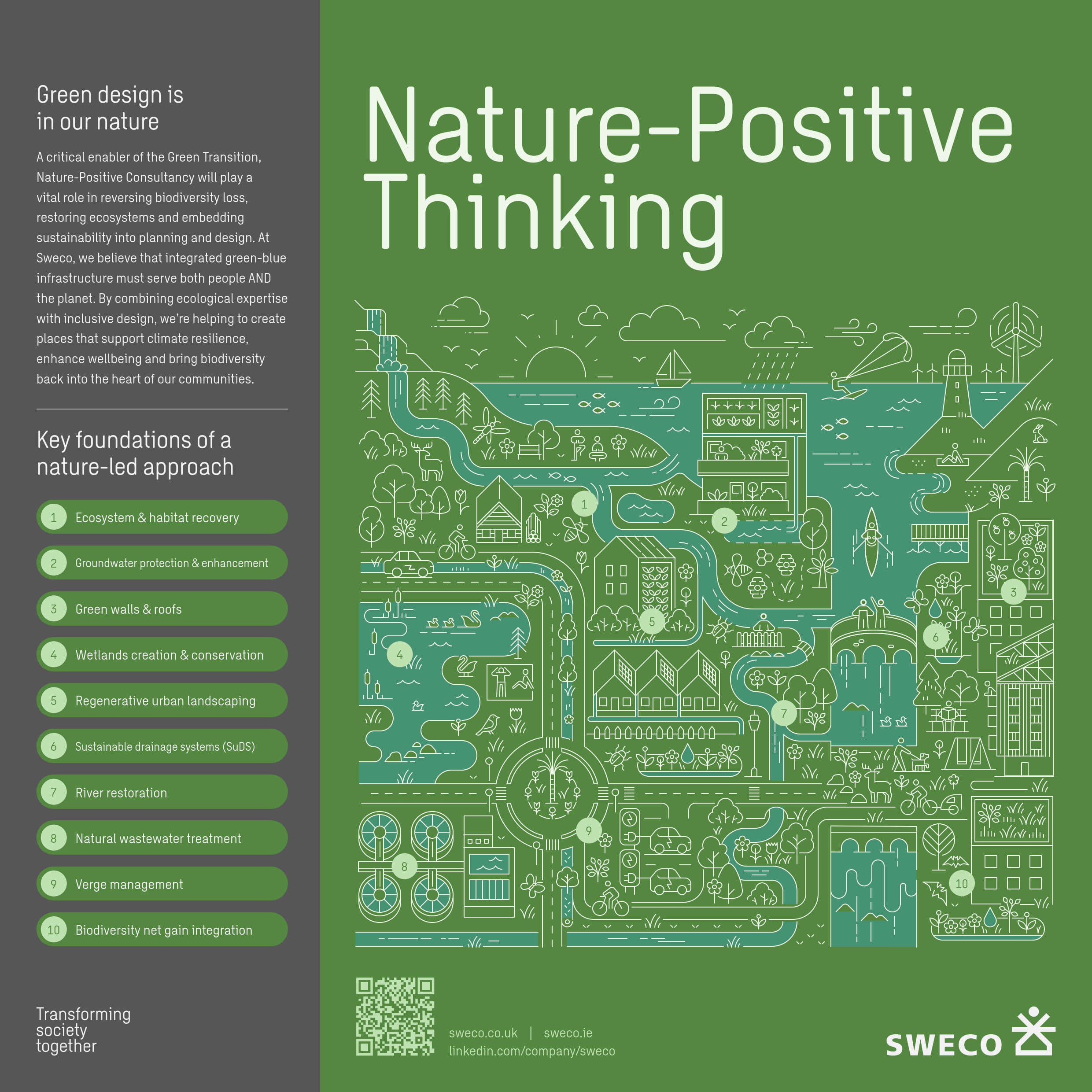
Nature positive thinking provides benefits for both people and the planet, and can also be more cost-effective than other alternative ‘non-natural’ alternatives. A core element of the green transition, focusing on nature not only reduce the impacts of climate change but actively enhances biodiversity – building resilience and enhancing adaptation to climate change by helping to safeguard human health, combat food and water scarcity and reduce the risk of disasters such as flood and extreme heat events.
With multi-disciplinary expertise across the planning, design, engineering and asset management lifecycle, we can guide you on the possibilities and opportunities of a nature-positive approach and also help implement and manage them with our global network of biodiversity and engineering specialists for long-term gains.
Integrating biodiversity early is not only a matter of ecological stewardship; it is an essential strategy for ensuring long-term resilience and sustainability of societies, economies, and individual projects. The benefits reach beyond immediate environmental concerns, touching on public health, resource security, and our overall quality of life.
By considering biodiversity from the very start, we can help safeguard the essential services that healthy ecosystems provide—clean water, fertile soils, climate regulation, and more—while also upholding our responsibility to future generations.
Sweco’s approach is rooted in collaboration, technical expertise, and a commitment to tangible outcomes. Rather than focusing on the risks associated with biodiversity loss, we instead concentrate on the opportunities for positive change that arise when nature is integrated into planning and development.
This means adopting nature-based solutions that restore urban and rural ecosystems, using digital technologies and data-driven insights to enhance biodiversity performance, and designing infrastructure that supports both ecological and human well-being.
We support our clients with practical tools and methodologies, from GIS-based biodiversity mapping and assessment, to the application of ecosystem service models and science-based targets for nature-positive development.
Our experts work alongside project managers to embed biodiversity considerations into every phase, identifying synergies with climate adaptation, circular economy principles, and stakeholder engagement. Through habitat restoration, green infrastructure, and innovative design, we demonstrate how biodiversity integration can bolster project resilience, reduce long-term operational risks, and generate measurable benefits for communities.