Sustainable Buildings Team
Sweco UK
How Velum Sky’s Campus Biotech B4 achieved BREEAM Outstanding through intelligent design
- Velum Sky adds a new sustainable gateway building to Campus Biotech B4 in Geneva, with flexible spaces for research, collaboration and campus life.
- Its BREEAM Outstanding rating, certified in February 2026, recognises a holistic approach to low-energy design, carbon reduction, biodiversity and occupant comfort.
- From AI design optimisation to a “breathing” façade and lake-water energy systems, the project shows how smart design can deliver both performance and architectural quality.
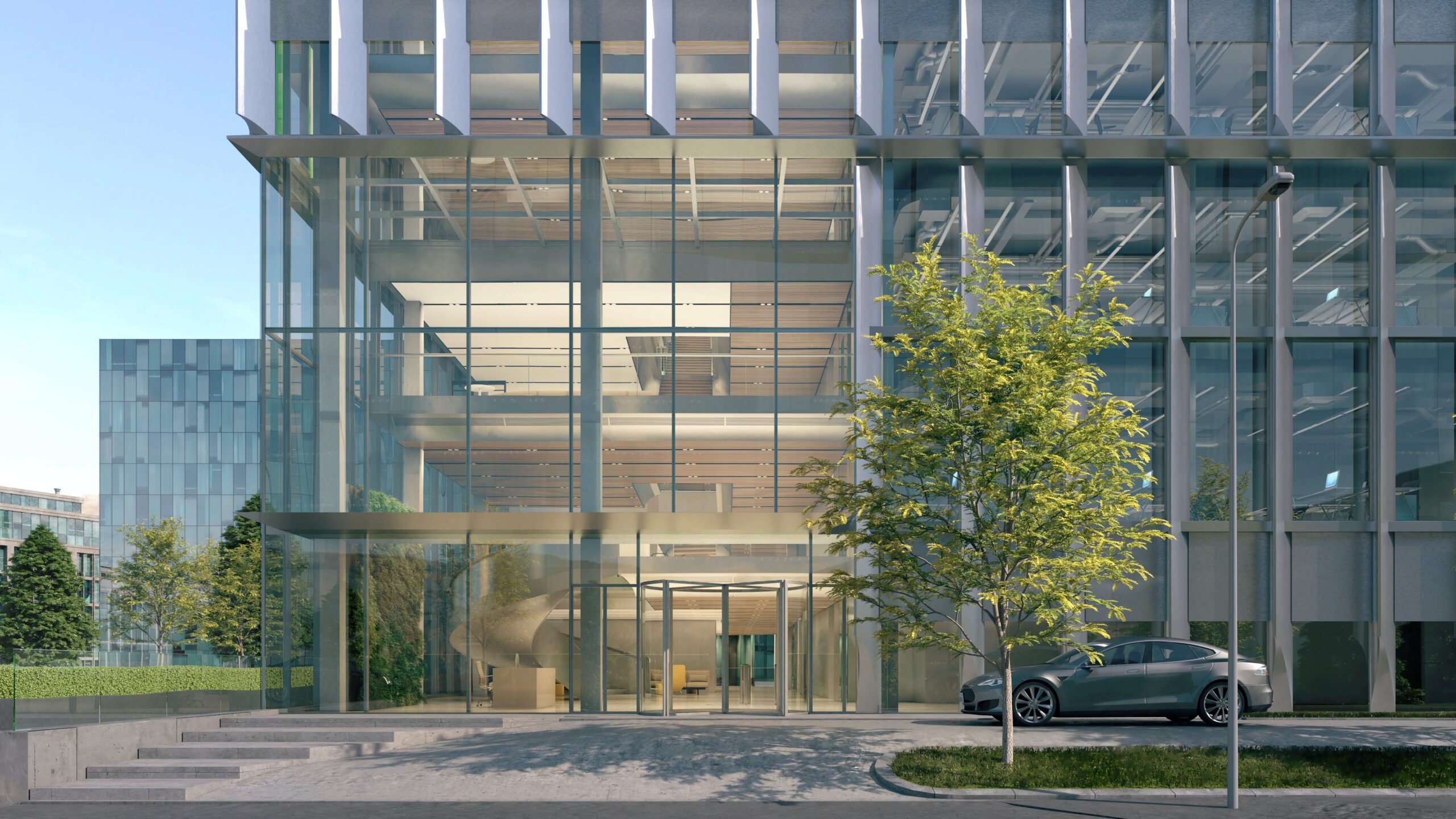
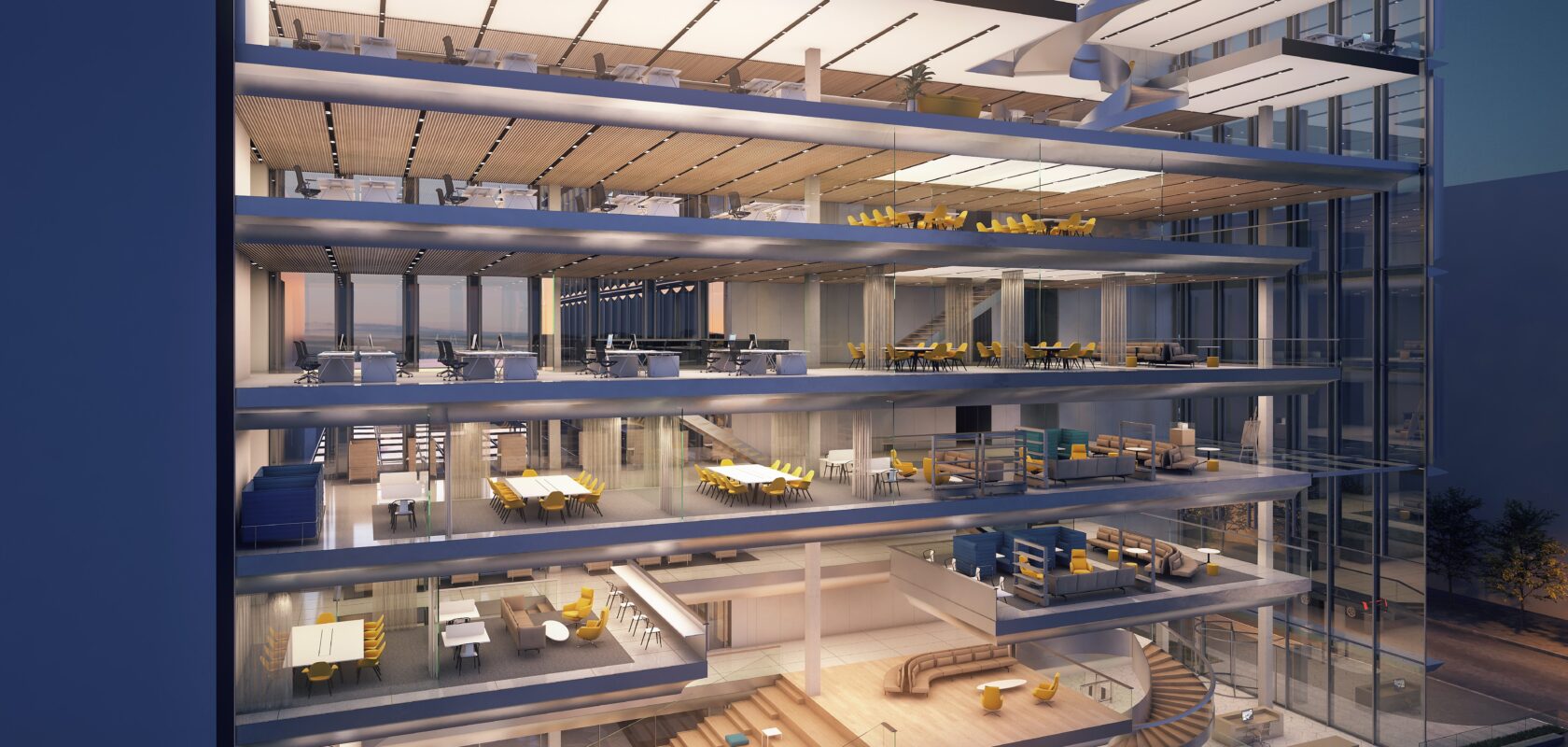
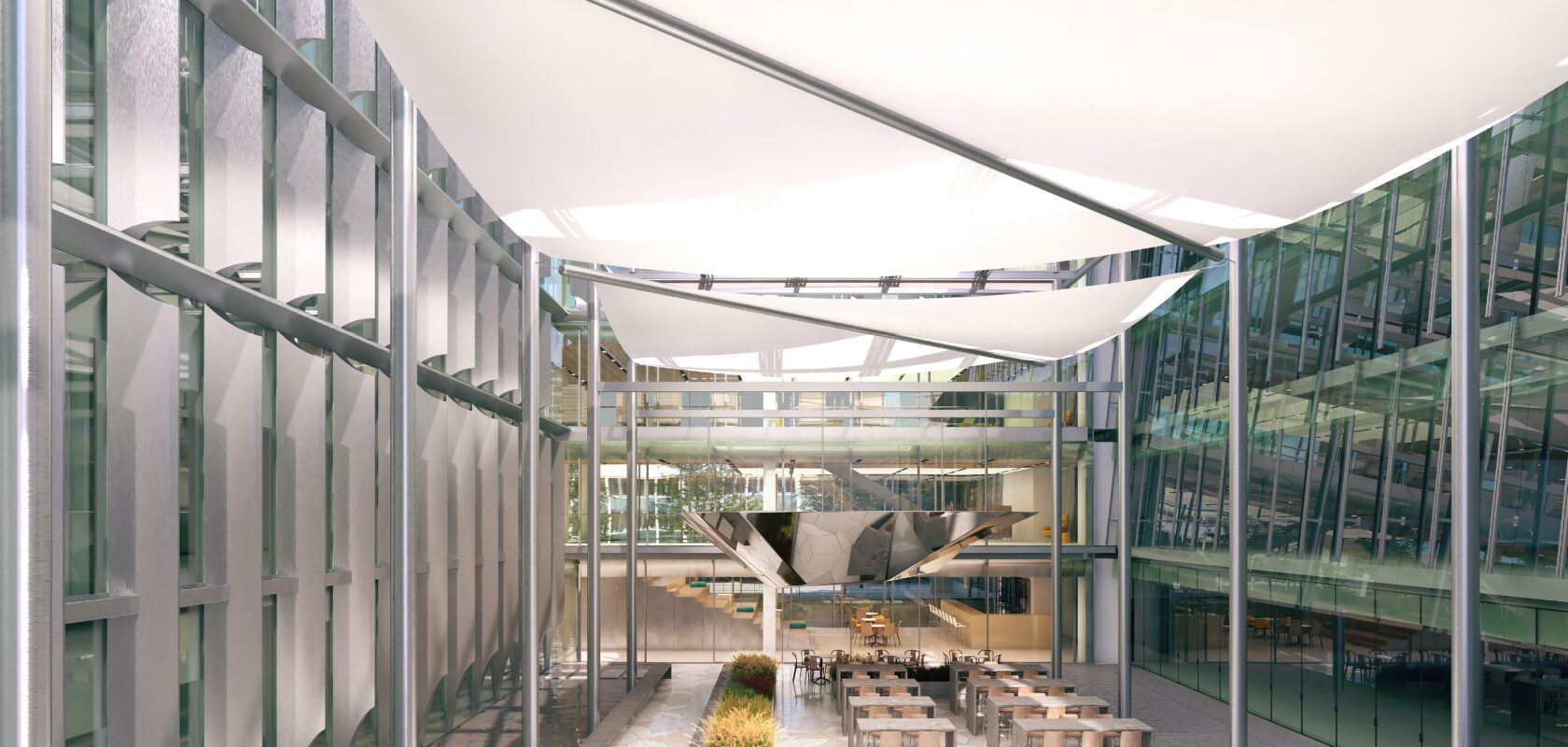
Velum Sky is a landmark extension to Campus Biotech B4 in Geneva, creating a new, highly sustainable gateway building. It provides a second main entrance and extends the campus’s shared research and collaboration spaces – bringing together flexible coworking areas, conference facilities, reception and café functions, alongside future-ready floors for research offices and laboratories.
Awarded in February 2026, the scheme’s BREEAM Outstanding certification reflects a holistic sustainability strategy which combines low-energy design, carbon reduction, biodiversity enhancement and occupant comfort. With a 70 kWh/m² annual energy target, lake-water connection, on-site PV, intelligent controls and a ‘breathing’ fin façade, the project exemplifies how ambitious environmental performance can be integrated with architectural quality and everyday usability.
This project is a strong example of how digital curiosity can lead to better buildings – using AI, advanced modelling and design optimisation to explore new ways of achieving the highest BREEAM standards to balance efficiency with sustainability and deliver something truly cutting-edge.
Rosi Cole, Senior Sustainability Consultant at Sweco
Velum Sky shows how strong BREEAM performance can sit alongside a broader buildings strategy that combines passive design, low-carbon energy, façade optimisation, thermal modelling and operational thinking.
Key sustainability objectives included achieving an energy target of 70 kWh/m² per annum, minimising cooling and heating demand, maximising the use of low-carbon and renewable energy, and enhancing local biodiversity and user well-being.
Parametric and thermal modelling, supported by AI-based optimisation, were used to test design options and understand the dominant loads. This showed cooling and off-season solar gains as the critical drivers. In response, the project team developed a façade strategy that pairs natural ventilation with external shading to deliver comfort with low energy demand.
Connected to the UNILAC lake-water network and supported by on-site PV, all-LED lighting, intelligent controls and climate-adapted landscaping, Velum Sky demonstrates a holistic, future-ready sustainable office concept tailored to its Lake Geneva setting.
Project snapshot
Velum Sky is the new gateway building to Campus Biotech B4 in Geneva, delivered for the Campus Biotech Geneva as part of the campus’s long‑term expansion. Designed by CP3 Architects with Sweco as sustainability and building physics consultant, the building provides c. 18,000 m² of flexible space supporting research, innovation and campus life.
The development brings together public‑facing functions – including reception, café, conference and collaboration spaces – with adaptable upper floors designed to accommodate research offices and laboratories over time. Its role as a second main entrance strengthens campus connectivity and identity while responding sensitively to its Lake Geneva setting.
Velum Sky was conceived as a demonstrator for next‑generation sustainable research buildings, integrating architectural expression, digital design methods and campus‑scale energy infrastructure to achieve BREEAM Outstanding certification.
Sweco’s expertise included Design for Performance, natural ventilation design, biophilic and ecology, thermal modelling and façade optimisation, computational fluid dynamics, BREEAM Certification, WELL Standard Certification, embodied carbon analysis and circular economy design.
Reducing energy use, improving comfort
Primary sustainability objectives focused on minimising operational energy, securing high thermal comfort, reducing CO₂ emissions and preserving the architectural ambition of a transparent, view-rich façade.
Energy reduction was achieved through passive and mixed-mode strategies. The façade integrates controllable openings and optimised fins to deliver free cooling when outdoor conditions are favourable, allowing mechanical cooling to be switched off in those zones. Exposed concrete soffits provide thermal mass to absorb daytime gains and support night-time purging.
Green roofs, tuned glazing g-values and automated external blinds significantly reduce incident solar gains and overheating risk. These measures were tested using thermal and CFD modelling to balance fresh-air supply with draught control.
Carbon reduction is underpinned by the campus-scale use of Lake Geneva as a renewable energy source, providing the majority of heating demand and all cooling rejection. This greatly reduces reliance on fossil fuels and associated emissions. Campus participation in SIG éco21 adds a structured framework for continuous reductions in energy and CO₂ over time.
Comfort objectives are met through an adaptive thermal comfort approach, user-operable façade elements, high daylight access and clear operational guidance, ensuring occupants can actively manage their environment while the building systems support energy-efficient operation.
What sets the project apart?
The project’s most distinctive feature is its fin-based façade system, which was refined using CFD analysis so it can draw in outside air, limit draught and allow natural ventilation to offset mechanical cooling when conditions permit. This integrated façade and HVAC approach supported strong performance across Energy, Health and Wellbeing, and Innovation categories.
The wider design also strengthens the building’s sustainability case. Green roofs and terraces reduce heat flux, urban heat-island effects and pollution, while exposed structural mass helps moderate temperature swings. Carefully selected glazing and automated external blinds further cut solar gains and improve comfort.
At system level, Lake Geneva provides a low- and zero-carbon energy source for both heating and cooling, supported by the campus SIG éco21 programme and robust modelling, including CFD and future-climate scenarios. Together, these elements reflect a genuinely performance-driven approach.
Innovative strategies for buildings used to achieve reduced emissions – like the cutting-edge ‘breathing building’ fin façade at Velum Sky – not only help protect the environment by reducing the need for mechanical ventilation, but can be core to achieving occupant wellbeing in the workplace too.
Monika Potomska, Senior Sustainability Consultant
Measurable environmental performance
The project delivers clear, quantified reductions in energy use, carbon emissions and water consumption, driven by PV generation, efficient building services, free cooling via natural ventilation and lake-water systems.
Dynamic energy modelling for BREEAM Ene04 shows that integrating low-/zero-carbon technologies – lake-water heat pumps, direct lake-water cooling and PV – reduces regulated carbon emissions from 11.8 to 8.1 kgCO₂/m² per year, a 31.4% improvement compared with an equivalent non-LZC building using gas boilers and no PV. On-site photovoltaic panels generate at least 6.27 kWh/m² per year, or around 90 MWh/year, directly offsetting grid electricity and lowering the operational carbon intensity of the development.
Free cooling through the natural-ventilation strategy delivers an 11% reduction in combined annual heating and cooling loads compared with a baseline with no openings or shading/thermal-mass strategy, while carefully maintaining comfort.
In addition, use of Lake Geneva as a hydrothermal source supplies up to 75% of campus heating demand and 100% of cooling rejection, removing the need for conventional cooling towers and their associated potable water and chemical use, while further cutting carbon emissions relative to fossil-fuel systems.
Biodiversity and landscape
Biodiversity is supported through extensive green roofs and a planted terrace on the seventh floor, which create habitats, improve microclimate and reduce pollution. Additional planting around the building enhances ecological value, improves air quality and provides visual amenity.
Collaboration from concept to construction
Collaboration was fundamental from the outset. The design team was involved from the earliest stages, with sustainability placed at the heart of the client’s brief. Before key design decisions were taken, the BREEAM Assessor was consulted to ensure the scheme would comply with relevant criteria and, crucially, to identify opportunities to embed additional sustainability measures beyond the minimum requirements.
Sweco, CP3 Architects, specialist CFD and environmental designers and building services engineers worked iteratively to refine the façade strategy, natural ventilation approach and integration with the lake-water energy system. This ensured that architectural intent, user comfort and low-energy performance were all aligned.
The collaborative process continued through construction, with sustainability requirements monitored season by season and regular dialogue maintained between the construction team, the design team and sustainability specialists to verify the most appropriate solutions at each stage of delivery.
From the earliest competition sketches, the vertical fins, external shading, and natural ventilation were imagined not as separate components, but as a unified architectural language. Working in close collaboration with Sweco allowed us to refine that vision into a façade of exceptional clarity and performance – where elegance and environmental intelligence are inseparable, and where architectural ambition and BREEAM Outstanding certification emerge from the same design gesture.
Stefano Cittolin, CEO of CP GROUPE Architects.
At Sweco, we offer full-service BREEAM expertise from new construction through to refurbishment, fit-out and ‘in-use’ both in the UK and internationally. Our BREEAM consultancy specialists have vast experience in domestic, non domestic and bespoke assessments for developments which aspire to achieve the highest levels of sustainability – and we also hold the certificate for the highest rated building in the UK (Bloomberg) with a score of 98.5%.