
Newsdesk
Sweco UK
Climate Transition Plan 2030
As Europe’s leading architecture and engineering consultancy, Sweco holds a distinctive role in the climate transition, one that goes beyond reducing the company’s own environmental footprint. Sweco is committed to the Paris Agreement and to reaching net-zero emissions by 2040. Our Climate Transition Plan sets out Sweco’s roadmap for halving emissions across our operations by 2030, a target validated by the Science Based Targets initiative (SBTi).
We continue to drive meaningful change and transform society in a more sustainable direction. I see every day how closely this transition is connected to the decisions that our 23,000 architects, engineers and experts make when planning and designing the cities and communities of the future. I also recognise Sweco’s dual role in addressing this pressing issue – both as advisors to our clients and as a company with its own climate footprint.
Åsa Bergman
President and CEO of Sweco
Sweco’s role in the climate transition
Sweco’s role is that of an enabler and accelerator. Through projects, expertise and local presence across Europe, Sweco supports clients in their sustainable transformation while reducing the environmental impact of its own operations and supply chain.
Drawing on knowledge base accumulated across markets and disciplines, Sweco can translate European best practices into locally feasible solutions at the scale and speed required by clients.
Sweco’s multidisciplinary consultancy services provide clients the technical expertise to make better choices throughout the entire lifecycle of a project.
In our client projects, Sweco identifies, shapes and applies the most innovative solutions with long-term consideration of people, the environment and society. This dual responsibility – enabling the clients’ transition while taking ownership of our own – is the foundation of Sweco’s approach to the climate transition.
Halving emissions by 2030
Sweco is a trusted advisor in the climate transition, supporting clients in the decisions and solutions that lead to Europe’s decarbonisation. This work is supported by science and technology, and steered by climate targets and transition plans.
Sweco’s long-term target is to reach net zero by 2040. By 2030, Sweco is commited to reducing Scope 1 and Scope 2 emissions by 90 per cent and Scope 3 emissions by 30 per cent, compared with 2020 levels. Together, these reductions are expected to halve the company’s greenhouse gas (GHG) emissions by 2030.
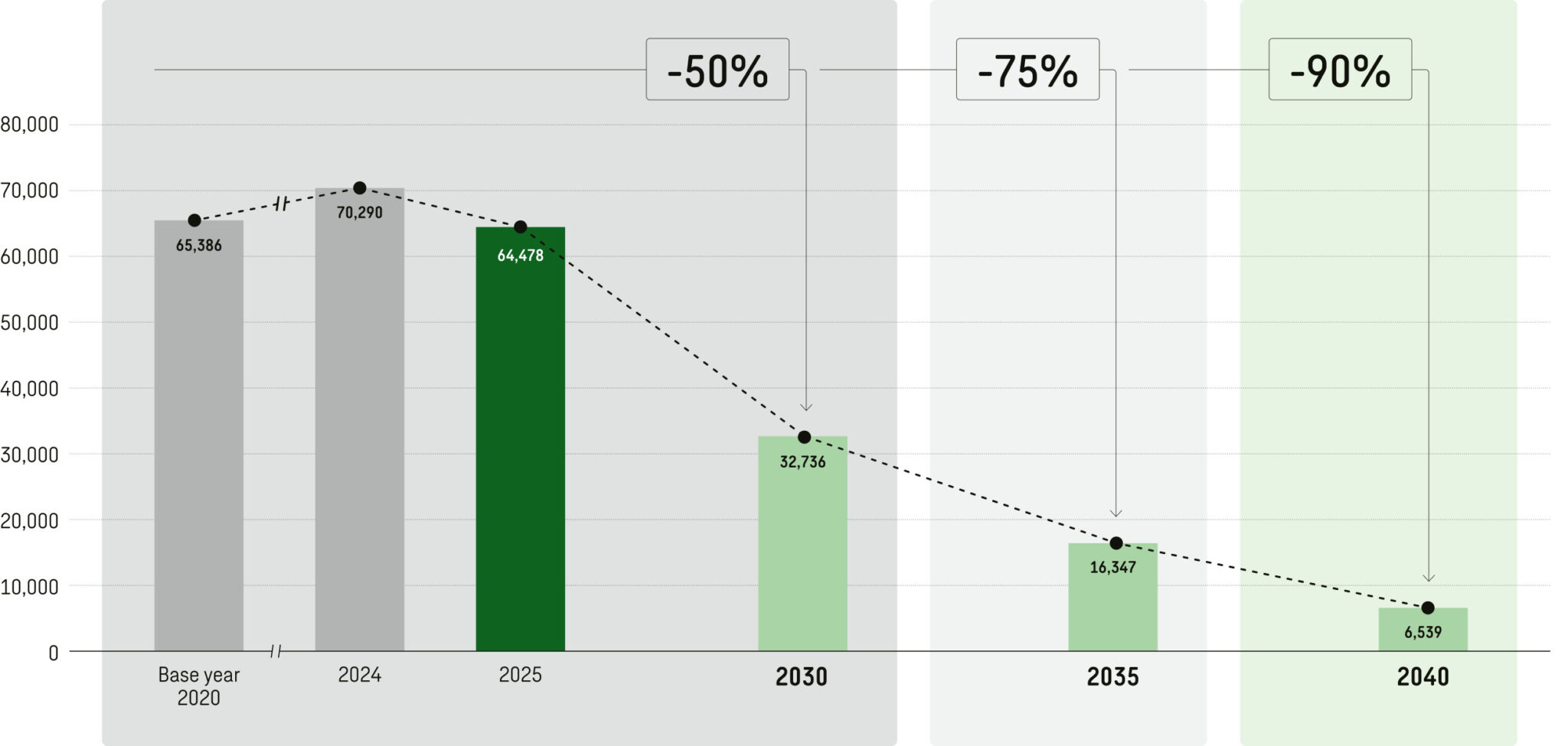 The targets are also consistent with the requirements of the EU Paris-aligned Benchmarks. All climate targets are defined as absolute emissions reductions and are measured in tonnes of carbon dioxide equivalent (tCO2e)
Roadmap to 2030
To support these climate ambitions, Sweco has identified a number of focus areas that guide the company’s roadmap to 2030, including fossil-free energy in offices, electrification of the vehicle fleet, decarbonisation of supply chain and sustainable mobility.
The central focus between now and 2030 is our supply chain, which accounts for around 50 per cent of Sweco’s total footprint. Achieving further reductions will require continued efforts to accelerate the transition across our supply chain including deeper supplier engagement and higher sustainability standards in procurement.
This climate transition plan underlines our determination for sustained action with clarity and transparency. It is based on five decarbonisation levers and defines the sub-targets, actions and KPIs required across these areas.
Five decarbonisation levers to reach the climate targets
To deliver the 2030 target, Sweco has identified five key decarbonisation levers:
- Fossil-free energy in offices
- Transition of the vehicle fleet
- Decarbonisation of the supply chain
- Sustainable mobility
- Circularity and resource efficiency
Together, these five levers provide a practical roadmap for reducing emissions, improving resource efficiency and supporting Sweco’s climate targets for 2030 and beyond.
Implementation follows Sweco’s decentralised model, with each Business Area responsible for implementing the plan locally in line with agreed targets. For each identified decarbonisation level, Sweco has established a set of supporting sub-targets and implementation pathways to guide progress across the organisation.
How is Sweco making progress?
Progress is monitored annually against the 2020 baseline year, which was selected as it represents the first year in which Sweco established comprehensive GHG data coverage and implemented Group-wide climate targets.
Since 2020, Sweco has reduced Scope 1 and 2 emissions by more than 60 per cent, primarily through the electrification of the vehicle fleet and increased use of renewable energy in offices.
The next phase of the transition requires a stronger focus on Scope 3 emissions, which represent the majority of Sweco’s climate footprint and are largely connected to suppliers, purchased goods and services, business travel and employee commuting.
The central priority between now and 2030 is our supply chain. Further reductions will require continued efforts to accelerate the transition across our supply chain including deeper supplier engagement and higher sustainability standards in procurement.
Achieving our climate ambitions will require close collaboration with employees, clients, suppliers and partners. While external factors such as renewable energy availability, transport electrification and supplier decarbonisation will influence the pace of progress, Sweco is committed to maintaining momentum and continuously strengthening its contribution to the climate transition.
The release of Sweco’s Climate Transition Plan marks an important step in turning our sustainability ambitions into practical action. In the UK & Ireland, we are already helping clients deliver lower-carbon solutions across buildings, infrastructure and the environment, while continuing to reduce emissions from our own operations. What is particularly encouraging is that this plan gives us a shared direction across the Group, ensuring that local action contributes to our collective global impact.
Gordon McGregor, Sweco UK Chief Sustainability & Digital Officer
Fossil-free energy in offices
Sweco is reducing the climate impact of its offices by improving energy efficiency and increasing the use of renewable and fossil-free energy. Key measures include prioritising energy efficiency when relocating or retrofitting offices, reducing gas dependency and working closely with landlords, property owners and energy providers. Smarter use of office space and better technical systems also help reduce energy demand.
Transition of the vehicle fleet
Sweco is accelerating the shift to low-carbon mobility by electrifying light vehicles and using fossil-free fuels where electrification is not yet feasible. The company is also expanding charging infrastructure at office locations to support this transition for employees, visitors and clients.
Decarbonisation of the supply chain
A major part of Sweco’s future emission reductions depends on the company’s supply chain. The focus is on high-impact procurement categories such as IT hardware and software, subconsultants, food and beverages, machinery, office furniture and interior materials. Stronger supplier engagement and better data quality are key to reducing upstream emissions.
Sustainable mobility
Reducing travel-related emissions requires more sustainable approaches to business travel, client site visits, internal meetings and commuting. Sweco is supporting this shift through more digital and hybrid meetings, reviewing how larger events are organised and promoting more sustainable travel choices. Improved access to public transport and cycling infrastructure near offices also supports lower-carbon commuting and employee well-being.
Circularity and resource efficiency
Circularity is an important enabler of Sweco’s transition. The focus is on increasing recycling and reuse in offices, especially for IT hardware, furniture and renovation materials. Sweco also works with suppliers and landlords to reduce material use, improve resource efficiency and support circular solutions, thereby lowering the company’s impact on the environment and nature.